Aperture, Shutter Speed and ISO: Read the Trade-Offs
Camera settings are easier to understand when each has a job. Choose the look you need, then decide which setting can compensate.
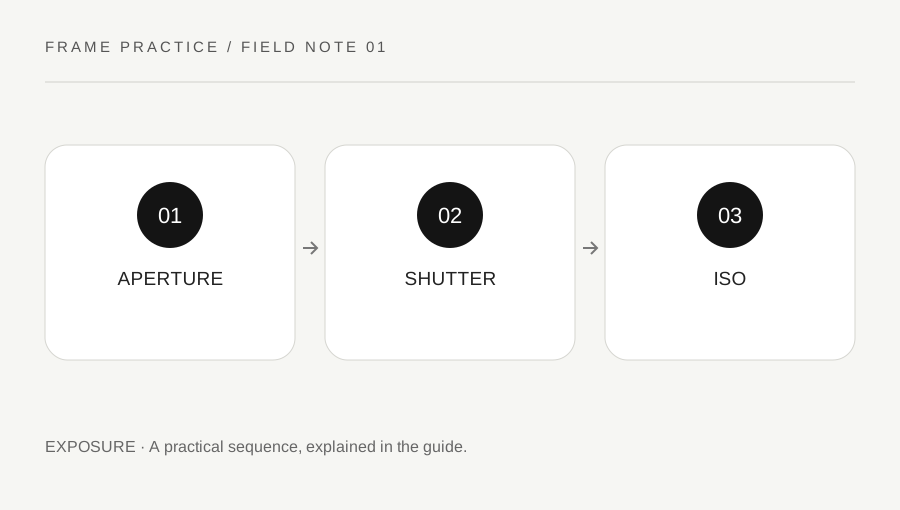
Original explanatory diagram. Numerical examples in this guide illustrate the reasoning; they are not a claim of hands-on testing.
Give aperture and shutter different jobs
Aperture describes the lens opening. A lower f-number means a wider opening, while a higher f-number means a narrower one. Aperture also affects depth of field, although subject distance, focal length and viewing conditions matter too.
Shutter speed controls the duration of the exposure. A longer duration can record more movement and more camera shake; a shorter duration can help freeze motion. Start by deciding whether subject movement or depth of field is the more important constraint for the photograph you want to make.
Use ISO with the correct mental model
ISO affects how the camera renders brightness for a given exposure and can involve image-quality trade-offs. Raising ISO does not create additional light arriving at the sensor. It can allow you to choose a shorter exposure time while keeping a similar rendered brightness.
For example, at a fixed aperture, moving from 1/125 second at ISO 100 to 1/250 at ISO 200 gives a conventional equivalent-brightness starting point. The subject-motion rendering changes because the exposure duration changed. The resulting image quality is not identical simply because the arithmetic balances.
Practice with one stationary subject
Photograph a stationary object near a window. Keep the light and framing consistent, then compare a wide aperture with a narrower one while compensating the shutter speed. Use a stable support when a slower shutter requires it. Do not evaluate motion blur from an exposure-equivalence calculation alone.
Write down which parts look sharp, what happened to the background and whether camera shake appeared. The calculator helps with setting relationships, but it does not meter the scene or recommend a safe hand-held speed. Read the camera manual for the exact controls and any automatic ISO behavior.
Work through a setting change from the photograph you want
Suppose your stationary scene is recorded at f/4, 1/125 second and ISO 100. You want more depth of field, so you choose f/8. The aperture relationship requires approximately four times the exposure duration to keep a conventional equivalent-brightness starting point at the same ISO. That gives about 1/31 second.
Now decide whether that longer duration is practical. If the camera is hand-held, camera shake may become visible. If a person enters the scene, subject movement may become relevant. Raising ISO to 400 allows the illustrative duration to return to about 1/125, but does not restore the original depth of field or guarantee identical image quality. The numbers balance one aspect of the decision while other visual properties change.
Make the photograph and inspect it. Check the important detail, the background and the highlights. If automatic ISO or another camera control is active, record what the camera actually selected. A manual calculation cannot explain a frame accurately if the recorded settings differ from the settings you thought were in use. The useful lesson is to connect an intended visual change with both the arithmetic and the observed result.
A practical checklist
Tick items for your own use. This checklist is saved only in this browser.
Questions that come up
Are equivalent settings identical photographs?
No. Similar rendered brightness can come with different motion blur, depth of field and image quality.
Why does f/4 to f/8 change time by four, not two?
The idealized light relationship follows the square of the f-number ratio. (8 ÷ 4)² = 4.
Will the calculator choose the correct exposure for a new scene?
No. It preserves an idealized relationship from settings you supply. Meter the actual scene and inspect the result.
References & scope
Background references checked on 18 October 2026. The examples and practice exercises are original editorial explanations, not copied procedures or professional advice.