A Composition Edge Check: Improve the Frame Before Pressing the Shutter
A composition does not become clear because a grid is visible. Check what the frame includes, what it cuts off and where your attention goes.
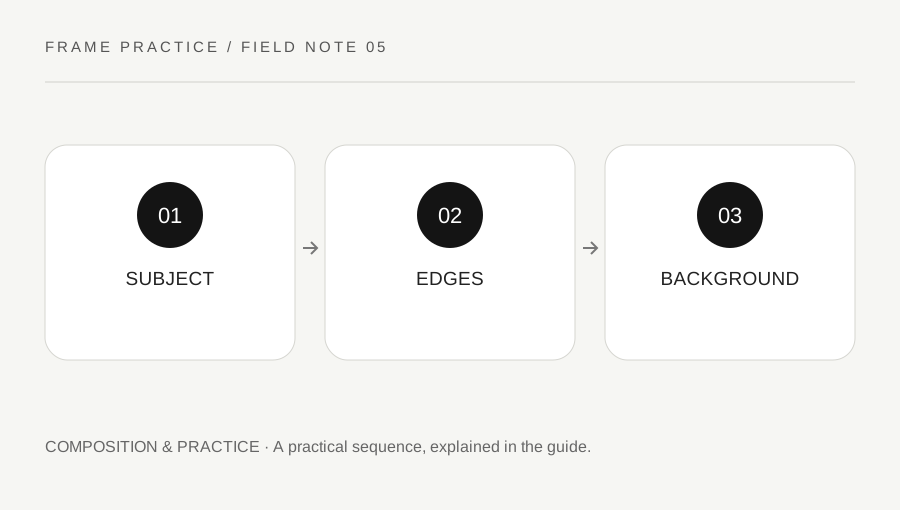
Original explanatory diagram. Numerical examples in this guide illustrate the reasoning; they are not a claim of hands-on testing.
Name the subject in one sentence
Before adjusting a grid, say what the photograph is about: “the curved handle against a dark background” or “one cyclist crossing the empty square.” If you cannot identify a subject or relationship, adding more elements rarely makes the decision clearer.
Choose a position that supports that idea. Move safely and respect access restrictions. A small step left or right can separate overlapping shapes without requiring a different lens. Do not trespass or step into a road to improve a background.
Inspect all four edges
Look around the frame perimeter for clipped hands, bright fragments, unwanted signs or objects entering awkwardly. Check behind the subject for poles, branches or competing high-contrast shapes. Decide whether each element contributes to the picture.
A useful exercise is to make one deliberate frame and then spend ten seconds inspecting only its edges before making a second. Adjust position or framing rather than automatically deleting every background detail. Context can be valuable; the question is whether the detail helps the intended photograph.
Compare alternatives with a reason
Make three versions: your first composition, a tighter frame and a version with more space around the subject. Keep the main idea consistent. Compare the visual weight and the relationship between subject and surroundings at the same display size.
Write one sentence explaining your choice. “The wider version shows the empty square and makes the cyclist’s route clear” is a meaningful decision. “It follows the rule” is less useful without a visible reason. Grids, symmetry and leading lines can support a composition, but they are tools for attention rather than a grading system.
Use an edge scan on a specific scene
Imagine photographing a café cup beside a window. Your main idea is the relationship between the cup handle and its shadow. Before the second frame, scan each edge: a bright napkin corner enters at the bottom, a bag strap crosses one side and a label competes with the handle.
Decide which details belong. You might move the napkin, change the camera position to exclude the strap and rotate the cup if you are allowed to arrange the scene. Alternatively, the wider surroundings may be part of the story, in which case a tighter crop could remove useful context. The decision comes from your intended photograph, not from a rule that backgrounds must always be empty.
Make two versions and compare at the same size. Write what changed in the path of your attention. Does your eye reach the handle and shadow more easily, or does the image now feel cramped? A careful edge scan is valuable because it turns an abstract composition idea into a few visible choices. Repeat the exercise on a different subject and keep the method while allowing the answer to change.
A practical checklist
Tick items for your own use. This checklist is saved only in this browser.
Questions that come up
Should the subject always sit on a thirds line?
No. A thirds grid is one option. Centered, symmetrical or deliberately unbalanced arrangements can work when they serve the image.
Should I remove all context to simplify a frame?
No. Context can explain place, scale or relationships. Remove distractions only when they weaken the photograph you intend.
Is cropping always a substitute for moving?
Cropping can help, but changing viewpoint alters overlaps and perspective in ways a crop cannot. Consider both before taking the frame.
References & scope
Background references checked on 18 October 2026. The examples and practice exercises are original editorial explanations, not copied procedures or professional advice.