Autofocus Hunts: Give It a Clearer Target Before Changing Equipment
A blank wall, reflective surface or small distant subject can make focus acquisition difficult. Read the camera’s limitations and compare a clearer target before treating every hunting lens as a fault.
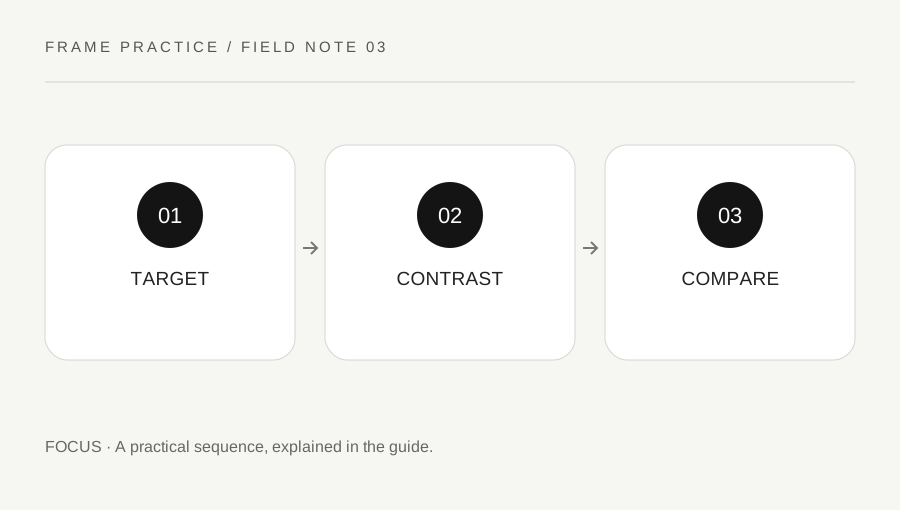
Original explanatory diagram. Examples illustrate a method or decision; they are not claims of personal testing.
Describe the focus behavior precisely
Notice whether the lens searches without confirmation, confirms on another area or captures a soft image despite an apparent lock. These are different observations. Record the light, subject distance, selected mode and focus area. A short harmless practice subject is more useful than repeating attempts on an uncertain scene while changing several controls.
Check the lens and camera mode and the supported focusing range. A subject closer than the lens can handle will not become focusable through repeated button presses. Nikon's manuals describe conditions in which autofocus may struggle, including low-detail or otherwise difficult targets. Use the exact model guidance rather than assuming every autofocus system has identical limits.
Choose a better detail at the intended distance
Where the composition allows, place the selected area on a clear edge or textured feature belonging to the intended subject. Do not focus on a more convenient background at another distance and assume the foreground will be sharp. Keep the test in suitable light and avoid aiming at unsafe bright sources such as the sun.
If the subject genuinely lacks detail, use a supported alternative such as manual focus with magnified assistance where appropriate. Do not attach an unsafe improvised target or alter an object you do not own just to complete the exercise. The purpose is a clear comparison that respects the scene and the equipment's intended use.
Work through a plain-object comparison
Imagine a smooth pale object under soft light. The camera hunts when the point sits on its blank center. The photographer moves the point to a visible edge at the same intended distance and repeats the supported focus operation. If acquisition improves, the target choice has provided a useful clue without proving every part of the system is perfect.
They make the image and inspect the actual detail. If it remains soft, they consider motion and depth as separate questions. This example is a practice comparison, not a promise that every reflective or low-contrast subject can be solved by selecting an edge. Some scenes need a different method or more suitable light.
Escalate from a controlled test, not a vague impression
If focus fails on ordinary clear targets within the supported range and light, record the result and consult the manufacturer. Include the camera, lens, mode and repeatable conditions. Do not run unknown calibration procedures or change service settings based on a single difficult subject. Keep equipment clean and maintained through its official instructions.
For everyday practice, retain a small sequence showing the original target and the clearer comparison. A useful outcome is understanding when to change the target, mode or setup, with a proper support route for a repeatable fault. It is not a universal claim that hunting always means user error or that another lens is the first solution.
Keep temporary focus aids out of the final frame
If an authorized removable aid is used under a suitable method, check that it has been removed or excluded before the final photograph and that the focus distance has not changed. Do not let solving one technical problem introduce a visible prop or alter the subject unintentionally. Review the complete frame after the focus check. This small transition from practice setup to final capture helps keep the photograph's purpose clear rather than judging success only by a confirmation indicator.
A practical checklist
Choices are saved in this browser. Reset them here or clear this site’s browser storage.
Questions that come up
Does hunting always prove a broken lens?
No. Difficult target conditions and settings can matter. Compare an ordinary clear supported setup before drawing that conclusion.
Can I focus on a distant background for a nearby blank object?
Do not assume that distance will suit the intended subject. Use an appropriate target or supported alternative method.
Should I change service calibration immediately?
No. Use ordinary supported tests and the manufacturer’s route for a repeatable problem.
References & scope
Background references checked on 18 October 2026. Worked examples and diagrams are original teaching material.