Focal Length and Camera Position: Make Two Different Comparisons
Changing focal length changes the view, while moving the camera changes the spatial relationship you see. Keep those actions separate in a simple exercise before deciding that a lens creates one inevitable look.
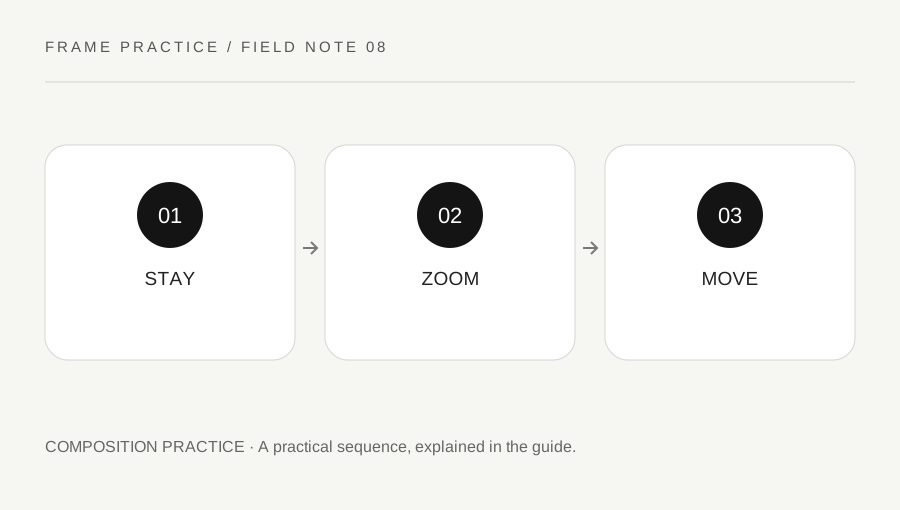
Original explanatory diagram. Examples illustrate a method or decision; they are not claims of personal testing.
Choose a scene with clear depth
Use a safe ordinary arrangement with a foreground object and a recognizable background at another distance. Keep the subject and camera positions easy to mark without creating an obstruction. Read the lens and camera instructions and use supported focal-length choices. A fixed lens can still support a position exercise, while a zoom makes the first comparison convenient.
Nikon's focal-length guide explains angle of view and magnification. Those concepts are useful, but do not turn a lens label into a complete explanation of the final image. Record whether you changed focal length, camera position or both. Otherwise, a comparison can attribute a position change to the lens alone.
Make the same-position pair
Keep the camera in one position and photograph with two supported focal lengths. Notice how much of the scene is included and the apparent size of details within the frame. Do not move closer between the first and second capture. Keep the chosen subject and exposure plan manageable so the comparison remains about the intended variable.
Review the pair at a suitable scale. If you crop or resize one image for comparison, label that action rather than treating it as an untouched capture. A tighter view is not automatically a different camera-to-subject relationship. The exercise should make the role of framing visible without relying on a dramatic slogan about lens compression.
Make a similar-framing position pair
Now change camera position and, where the equipment permits, adjust focal length so the main subject occupies a similar part of the frame. Observe the background and relative spacing. Keep every move safe and respect access, property and people in the area. A photograph is not worth stepping into traffic or moving beyond a permitted boundary.
Imagine a tabletop object with a second object behind it. The near-camera version and a farther-camera version can show different relative relationships even when the main object is similarly framed. These are practice observations, not a guarantee of a specific numerical effect for every lens and distance. Record the actual positions and compare the image rather than memorizing a universal appearance label.
Use the distinction in a real composition
Before changing equipment, ask whether the issue is unwanted background coverage, the subject's relationship to the background or your actual shooting position. A focal-length adjustment may answer one question, while a safe position change answers another. The scene can impose limits, so use what is possible rather than treating movement as always available.
Keep the accepted frame and a short note explaining the deliberate choice. Do not infer that a focal length is universally flattering or unsuitable from one exercise. A useful understanding of perspective helps you choose a view for the subject and purpose, with angle of view and position considered separately instead of assigning every spatial effect to a lens number.
Keep close-focus limits in view
Moving closer can bring the subject inside the lens's minimum focusing distance or make the intended sharp region difficult to achieve. Check the actual equipment limits and review focus after every significant move. Do not force the focus ring or lean an unstable setup closer to gain a framing match. If the comparison cannot be made safely with the equipment available, choose larger objects or a different arrangement. The exercise is a learning aid, not a requirement to reproduce an exact frame at any cost.
A practical checklist
Choices are saved in this browser. Reset them here or clear this site’s browser storage.
Questions that come up
Does a lens number alone determine perspective?
Camera position is central to the spatial relationship. Keep position and focal-length changes distinct in the comparison.
Can I crop a comparison image?
Yes, if you label it and understand that cropping is another action rather than an unchanged capture.
What if moving closer prevents focus?
Respect the lens’s supported range and choose a different safe practice arrangement.
References & scope
Background references checked on 18 October 2026. Worked examples and diagrams are original teaching material.